A custom B2B software development company in Dubai — or a B2B software development company USA teams evaluate for Western delivery — is usually hired for one reason: standard tools no longer represent how the business actually works.
This article covers both UAE and US commercial investigation. The underlying problem is often universal. The market context is not identical. For country-specific positioning, see Largify’s markets hub, UAE, and United States pages. Dedicated commercial landing pages should stay separate rather than stuffing both cities into every H1.
If you are still clarifying scope before a build, start with how to scope a software development project. For ERP-shaped problems, see Custom ERP vs SaaS cost.
What Is Custom B2B Software Development?
Custom B2B software development means building software around a company’s specific business processes rather than asking the company to adapt its operations to an existing product.
That could mean:
- Internal business software
- Customer portals
- B2B marketplaces
- Enterprise dashboards
- Workflow platforms
- CRM systems
- ERP systems
- Procurement platforms
- Logistics software
- Industry-specific applications
- SaaS products
The important distinction is ownership of the workflow. A generic SaaS product gives you a predefined system. Custom software starts with: your users → your workflows → your data → your business rules → your system.
That difference becomes important when standard tools stop fitting the business.
Why B2B Companies Consider Custom Software
Most businesses do not start by wanting custom software. They usually start with existing tools — CRM, accounting, spreadsheets, project management, a customer portal, and communication tools.
At first, this is manageable. Then the company grows. Sales needs information from operations. Operations needs information from finance. Customers want portal access. Management wants consolidated reporting. Employees start copying information between systems.
The business eventually has a software problem rather than a software shortage. There are already plenty of tools. The problem is that they do not operate as one system.
Custom Software vs Off-the-Shelf Software
The decision should not be “custom software = good” and “SaaS = bad.” Both approaches have legitimate use cases.
Off-the-shelf software
Usually makes sense when:
- Your workflow is relatively standard
- The required features already exist
- Configuration is sufficient
- Integrations are available
- You want faster deployment
- You do not need ownership of the underlying product
Custom software
Becomes more relevant when:
- Your workflows are unusual
- Multiple systems need to communicate
- Existing tools create workarounds
- You require specific permissions
- Your customer experience is part of your competitive model
- Your business has proprietary processes
- Existing products cannot support important requirements
The question is not whether custom software is more sophisticated. The question is whether standard software can represent your business without creating unnecessary friction.
When Should a UAE Business Consider Custom Software?
A Dubai or Abu Dhabi company may start considering custom development when several operational problems appear together:
- Multiple systems contain the same information — customer data lives in CRM, spreadsheets, accounting, and booking tools.
- Employees repeatedly transfer data — someone exports from one application and manually enters it elsewhere.
- Management reporting is manual — reports require combining information from different systems.
- Customers need a dedicated portal — a standard SaaS dashboard does not provide the required experience.
- Business rules are highly specific — the workflow does not match how standard software expects the process to work.
- Branches operate differently — locations need shared central data while keeping branch-level permissions and workflows.
- Integrations have become critical — multiple external platforms must exchange data reliably.
These are stronger reasons for custom development than simply wanting a “modern” application. For UAE delivery context — Dubai, Abu Dhabi, Sharjah, AED workflows, and local integrations — see Largify’s UAE market page. Related reading for growing multi-location operations: multi-branch management systems and cloud ERP for Dubai SMEs.
Search terms such as enterprise software development agency in Abu Dhabi and bespoke workflow automation software Dubai usually point to this same investigation: can the existing stack still support operations without expensive workarounds?
What About US Businesses?
The same underlying problems exist in the United States. A US company may already run CRM, ERP, accounting, customer portal, internal applications, payment systems, communication platforms, and analytics tools. The question becomes how those systems interact.
For a growing B2B company, software may eventually become part of the operating infrastructure. A customer may expect: Login → Orders → Invoices → Documents → Support → Account management.
If those functions exist across unrelated systems, the customer experience can become fragmented. A custom B2B platform can bring those workflows into one controlled environment — which is why buyers search for custom B2B software development USA and custom web application development USA rather than another generic app build.
Largify’s US market page covers Western delivery context around MVP builds, offshore engineering economics, IP protection, and US-friendly contract workflows.
UAE and US Requirements Are Not Identical
Geographic targeting should change substance — not only the city name in the headline.
The underlying software architecture may be similar. The business context is not always the same.
UAE projects may involve
- Dubai or Abu Dhabi operations
- AED transactions
- UAE VAT-related workflows
- Multi-branch businesses
- Arabic and English interfaces
- WhatsApp-based customer communication
- GCC expansion
- Local operational integrations
US projects may involve
- US-based customer workflows
- USD transactions
- US time-zone operations
- SaaS and MVP development
- Enterprise integrations
- Customer portals
- B2B workflows
- IP ownership requirements
- Distributed teams
That is why Largify treats UAE and USA as related but distinct delivery markets under the broader markets structure — rather than duplicating one page with swapped city names.
What Can Custom B2B Software Include?
A B2B platform might contain several layers. The final architecture should be based on actual requirements rather than a predetermined module list.
Customer layer
- Customer accounts and portal
- Orders, documents, billing
- Support and notifications
Internal operations
- CRM and sales pipeline
- Projects, tasks, employees, approvals
- Inventory and procurement
Management
- Dashboards and KPIs
- Revenue and operational analytics
- User activity reporting
Integration layer
- Payment systems and accounting
- CRM, email, messaging
- External APIs and enterprise systems
Custom B2B Software Is About Workflows, Not Screens
One of the biggest mistakes in software projects is starting with “we need a dashboard.” The dashboard then depends on customer data, sales data, financial data, inventory, permissions, and API integrations.
The dashboard was never the real requirement. The real requirement was connected business information.
That is why Largify’s scoping process starts with business requirements, users, workflows, feature requirements, and technical architecture before development — as explained in how to scope a software development project.
Example: A B2B Customer Portal
Imagine a distributor serving hundreds of business customers. Customers currently email orders, request invoices, ask for delivery updates, request documents, and contact support. Employees manually process each request.
A custom B2B portal could provide: Customer login → Product catalogue → Order placement → Order status → Invoices → Documents → Support → Account history.
The customer gets self-service access. The internal team gets structured data. Management gets centralized visibility. That is a business workflow worth evaluating for custom software — closer to custom software or even a productized path via SaaS product development if the portal becomes a commercial offering.
Custom Software Can Also Replace Spreadsheets
A spreadsheet is not automatically a problem. It becomes a problem when the spreadsheet is effectively acting as the company’s database.
Five employees edit the same customer spreadsheet. One downloads a copy. Another changes a record. A third sends the old version to management. Now nobody is certain which file is correct.
A database-backed application can introduce controlled access, structured records, validation, audit history, role-based permissions, shared data, and automated workflows. For a deeper breakdown, see when to replace spreadsheets with custom software.
How Much Does Custom B2B Software Cost?
There is no reliable single price for “custom software.” The scope determines the cost.
A small internal application might require authentication, a few workflows, a database, and basic reporting. A larger B2B platform may require multiple user roles, customer portals, mobile applications, complex permissions, multiple integrations, billing, advanced reporting, multi-tenancy, automation, AI, and high-availability requirements.
Those are completely different projects. Before estimating cost, define:
- Users
- Workflows
- Features
- Integrations
- Data
- Permissions
- Platforms
- Security requirements
- MVP scope
- Future requirements
A software company should be cautious about giving a serious estimate after hearing only “we need a CRM.” A CRM can be a simple lead tracker or an enterprise platform.
Custom Software Development for Dubai and Abu Dhabi
Dubai businesses often operate in environments where speed, multiple branches, multilingual customers, and integrations can all matter. A custom system may therefore need to connect: Sales → Customer → Operations → Inventory → Finance → Reporting.
For example, a multi-branch service company could require centralized management while each branch controls its own employees, bookings, and transactions. The architecture should reflect that structure — which is also why buyers look for a custom B2B software development company in Dubai that can map operations before writing code.
Custom B2B Software Development for US Companies
For US companies, the same principle applies. A B2B platform might connect: Lead → Opportunity → Contract → Customer → Order → Billing → Support → Renewal.
The software becomes more than a CRM. It becomes the operational layer connecting the customer lifecycle. For startups, this may also become the foundation of a product that will eventually be sold to other businesses — which changes the architecture significantly and often points toward SaaS product development.
Custom Internal Software vs SaaS Product
This distinction is important.
Internal software
Built for one organization. Example: a logistics company needs a custom dispatch and operations system.
SaaS product
Built for multiple organizations. Example: a company wants to sell a logistics management platform to hundreds of businesses.
The second requires additional architecture around multi-tenancy, subscription billing, tenant isolation, onboarding, account administration, product analytics, and scalable infrastructure.
If the goal is to build software that will become a commercial SaaS product, Largify’s SaaS product development approach is more relevant than treating the project as an internal application alone.
How ValionOS Demonstrates the Connected-System Approach
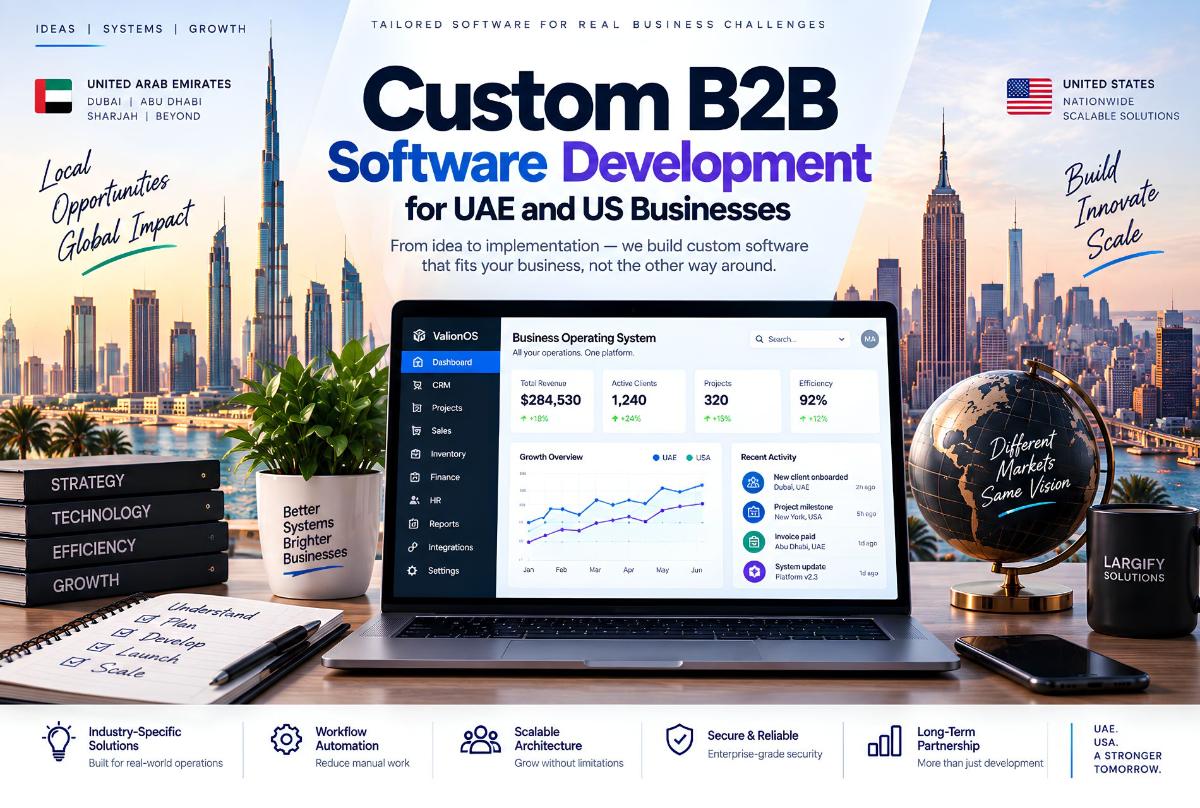
Largify’s ValionOS is an example of the broader approach. It is designed as a multi-industry business operating system connecting operations, automation, customer management, and AI-powered workflows in a multi-tenant SaaS model.
Its relevance to custom software development is not that every business should use ValionOS. The useful lesson is architectural: business functions become more useful when the underlying data and workflows are connected.
For a company evaluating custom software, ask: which processes should become one connected system? That question is more useful than “which features should we add?”
Read the ValionOS case study for how Largify approaches modular ERP, shared business data, automation, and AI within one operating platform.
Avoeline: Building Around an Actual Operational Problem
Largify’s Avoeline case study provides another example of this principle. The platform was designed around event-management workflows that were previously fragmented across forms, spreadsheets, attendance records, certificates, payments, and analytics.
The product approach connected those steps into a more unified digital environment. That is the kind of problem custom software can address — not “we need an app,” but “our process is fragmented and the software needs to connect it.”
How Largify Approaches Custom Software Development
Largify’s delivery model follows Discovery → Build → Launch. Discovery is used to determine whether the project actually needs custom software, what the first sprint should contain, and where the major constraints are — mapping product fit versus custom build before expanding development.
A practical custom software project should establish:
- Business objectives — what problem is being solved?
- Users — who will use the system?
- Workflows — what actions do users perform?
- Data — what records does the system need?
- Permissions — who can see and modify each record?
- Integrations — which external systems must communicate?
- MVP — what is required for the first useful release?
- Architecture — what technical foundation supports current and expected requirements?
- Acceptance criteria — how will everyone determine the system is complete?
This approach reduces the risk of building features before understanding the business process. Explore custom software development for the service path, or ERP development when the need is a company-wide operational system.
Common Custom Software Mistakes
- Building everything at once — a B2B platform can quickly become too large to validate. Start with the operational core.
- Choosing technology before defining requirements — the stack should support the architecture, not determine the business process.
- Treating integrations as simple features — “integrate accounting” can be a substantial technical project.
- Ignoring permissions — B2B applications often contain commercially sensitive information.
- Designing screens before workflows — a polished interface cannot fix a broken process.
- No defined MVP — without a first release, the project can expand indefinitely.
- No change-control process — new requirements will appear; evaluate them without silently expanding scope.
Should You Build Custom Software or Buy SaaS?
Use this simple framework:
| Situation | More suitable direction |
|---|---|
| Standard business workflow | SaaS |
| Need to launch quickly | SaaS |
| Existing product fits requirements | SaaS |
| Highly specialized workflow | Custom |
| Multiple systems must be unified | Custom or integration |
| Proprietary customer experience | Custom |
| Building a software product to sell | SaaS product development |
| Company-wide operational system | ERP or custom ERP |
| Small isolated process | Existing tool or automation |
There is no prize for choosing custom software. If SaaS solves the problem cleanly, use SaaS. If SaaS forces the business into workarounds, investigate custom development.
UAE and US SEO Should Also Be Separated at the Landing-Page Level
This article establishes the broader topic for both markets. Dedicated commercial pages should still target local intent separately — for example Dubai- and Abu Dhabi-focused custom software pages versus US-focused B2B and web-application pages — with different market context rather than duplicated copy.
Until those landing pages are published, use the existing market hubs: UAE, USA, and all markets, then link into custom software development.
Final Takeaway
Custom B2B software — including custom business software development and enterprise software development — makes sense when the software needs to reflect the way the company actually operates.
For a Dubai business, that may involve multi-branch operations, AED workflows, local integrations, and bilingual customer experiences. For a US business, it may involve B2B customer portals, SaaS products, enterprise integrations, distributed operations, and product ownership.
The geography changes the context. The underlying principle stays the same: do not build custom software because existing software is imperfect. Build it when the limitations of existing software create a business problem worth solving.
Largify works across both UAE and US markets and can help evaluate three paths: deploy a product, engineer a custom system, or implement an ERP / business operating system.
For market-specific scope and pricing, see ERP software development in the USA, ERP development in Dubai and MVP development for US startups.
Frequently Asked Questions
When does a business need custom B2B software?
Usually when standard software cannot adequately support important workflows, integrations, permissions, customer experiences, or proprietary processes.
Is custom software more expensive than SaaS?
The initial development investment is generally higher because the system is being built specifically for the organization. Whether it creates better long-term economics depends on the business, existing software costs, manual work, integrations, and operational requirements.
Can a software company in Pakistan develop software for US businesses?
Yes. The relevant questions are delivery model, communication, IP ownership, security, contracts, technical capability, and project governance rather than simply where the engineering team is located. Largify’s Engineering Team from Pakistan, USA and Saudi Arabia delivers to both Gulf and Western markets — see the markets page.
Can custom software serve both UAE and US operations?
Yes. A single platform can support multiple regions when the architecture accounts for differences in users, currencies, workflows, permissions, integrations, and regional requirements.
Should a startup build custom software?
If the software is itself the startup’s product, custom product development may be necessary. If the startup simply needs internal tools, existing SaaS products may be more practical.
Need Custom B2B Software for Your Business?
Start with the workflow, not the technology.
Largify helps businesses evaluate the difference between an existing SaaS product, custom software, ERP, and a broader business operating system before development begins — across UAE and US markets with an Engineering Team from Pakistan, USA and Saudi Arabia.
Explore custom software development · markets · ValionOS case study · Avoeline case study · project scoping guide.
Start a project discussion with Largify if you already have a workflow that needs to be turned into software.