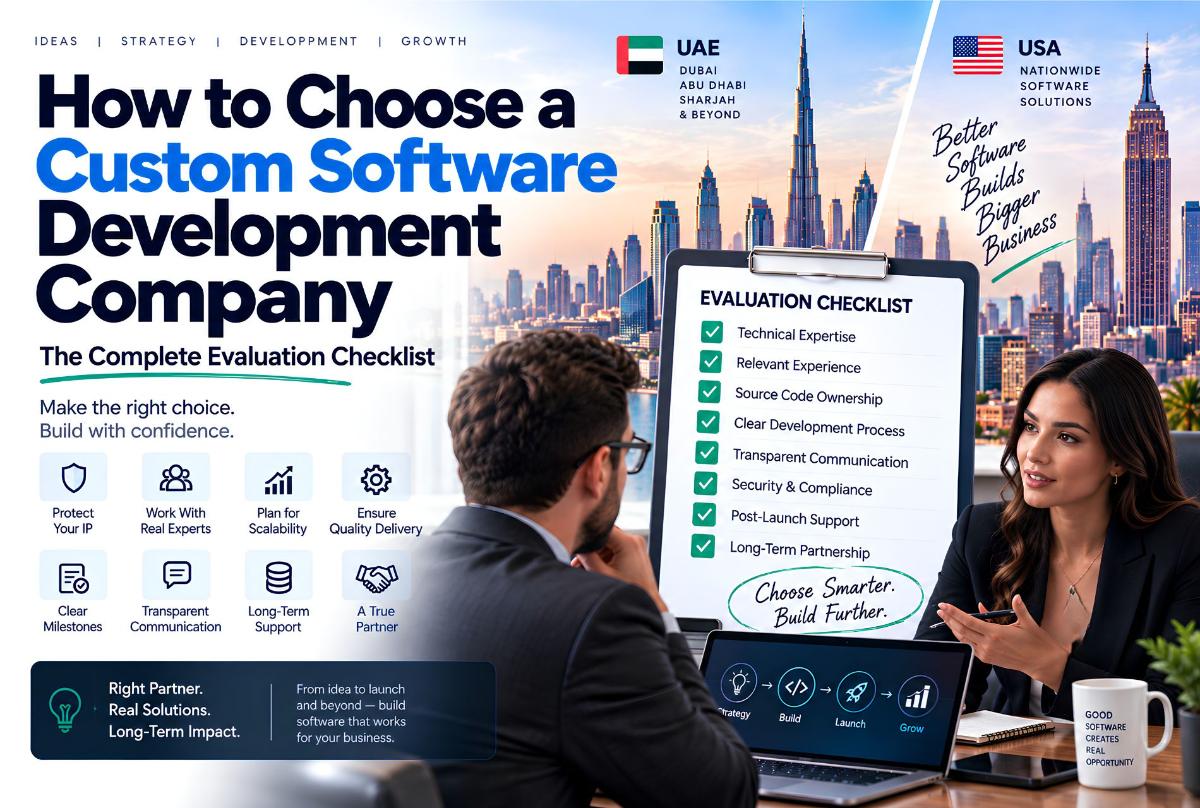
Hiring a custom software development company is not the same as hiring someone to build a website.
You are potentially giving an external team responsibility for your business logic, customer data, source code, product architecture, integrations, security, deployment, and future maintenance.
The cheapest proposal can therefore become the most expensive decision if the architecture is weak, ownership is unclear, or every change turns into a new negotiation.
The better question is not “Which company charges the least?” It is: Which development partner can build the right system, with clear ownership, controlled scope, transparent delivery, and an architecture that will still work when the business grows?
This checklist is designed to help founders, COOs, operations leaders, and business owners in the UAE and United States evaluate that decision before signing a development contract. For scoping discipline before you request quotes, see how to scope a software development project. For the service path, see custom software development.
1. Start With the Business Problem
Before comparing development companies, define what you actually need to solve.
For example: “We need an ERP.” That is not enough information to produce a meaningful proposal.
A better requirement might be: “Our sales, inventory and finance teams currently work across separate systems. We need one platform connecting customer orders, stock, invoicing and management reporting.”
Now the development partner can start asking useful questions. The difference matters because custom software should be designed around workflows, not simply around a list of screens.
Largify’s software-scoping guidance recommends defining the business problem, users, workflows, requirements, integrations, exclusions, and acceptance criteria before development expands — covered in how to scope a software development project.
2. Does the Company Actually Build Custom Software?
Some companies sell themselves as custom software developers while primarily assembling templates, plugins, no-code tools, existing SaaS products, or prebuilt components.
There is nothing inherently wrong with using existing technology. The question is whether the company can engineer something genuinely tailored when your requirements go beyond what existing software provides.
Ask: Have you built proprietary software before? Can you show working products? Have you built systems with complex workflows? Can you explain the architecture? Can you maintain the system after launch?
A development partner should be able to explain what it actually built, not just show a collection of polished screenshots.
3. Ask for Real Product Evidence
A portfolio should contain more than “E-commerce Website,” “CRM Application,” or “Mobile App.” Ask what the company actually contributed.
Useful questions include: What was the original business problem? What did you build? What integrations were required? Was the product custom or based on an existing platform? What parts are still maintained? Can I see a live product? Can I review a detailed case study?
This separates genuine engineering experience from portfolio decoration. Start with Largify’s case studies and the ValionOS case study.
4. Check Whether They Understand Architecture
You do not need to be a software engineer to test this. Ask: “How would you structure this system if we expect the number of users and branches to grow?”
A serious development partner should be able to discuss frontend, backend, database, APIs, authentication, permissions, infrastructure, integrations, monitoring, backups, and scalability.
You do not need a 50-page architecture document before signing. You do need evidence that someone has thought beyond the first release.
5. Ask What Happens When the Business Grows
Imagine your business currently has 1 branch and expects to have 20 branches in the future. The software architecture should account for that possibility if multi-branch expansion is reasonably foreseeable.
Ask: Can the system support multiple organizations? Can it support multiple branches? Can permissions be separated? Can data be isolated? Can new modules be added? Can integrations be introduced later? Can the infrastructure scale?
Not every system needs enterprise architecture on day one. Overengineering is also expensive. The objective is to avoid building something that has to be thrown away immediately after the first stage of growth. Related reading: multi-branch management systems.
6. Understand Who Owns the Source Code
This is one of the most important contract questions. Ask explicitly: Who owns the source code after payment? Do not assume the answer.
Your agreement should clearly address source code ownership, intellectual property, design files, database ownership, documentation, deployment configuration, credentials, third-party accounts, and reusable components.
If ownership is unclear, you can end up paying for software that you cannot independently control.
7. Ask About Intellectual Property Rights
Source-code ownership and intellectual-property rights should be addressed contractually.
What belongs to you?
For example: custom application code, custom designs, business logic, product documentation, and customer data.
What belongs to the development company?
For example: pre-existing frameworks, internal development tools, reusable libraries, and generic components.
This distinction is normal. The important thing is that both sides understand it before development starts.
8. Do Not Ignore the Repository
Ask: “Where will the source code repository live?”
Developer-owned repository
The development company controls it. This creates dependency.
Client-owned repository
The client controls the primary repository and grants the development team appropriate access. This can provide greater continuity.
Shared arrangement
Both parties have defined access under the contract.
The important thing is not which model sounds most impressive. It is whether you can continue operating the product if the relationship ends.
9. Ask About Deployment Ownership
Source code is only one part of the system. What happens with cloud hosting, database, domain, DNS, payment gateway, email provider, SMS, WhatsApp, analytics, App Store accounts, and API keys?
Ideally, important production accounts should not be permanently trapped inside a developer’s personal accounts. Your business should know what infrastructure exists and who controls it.
10. Look for a Clear Development Process
A development company should be able to explain how a project moves from idea to production.
Largify describes its delivery model as Discovery → Build → Launch, with discovery used to establish product fit, constraints, and first-sprint outcomes, followed by development with demos and acceptance criteria.
- Discovery
- Build
- Launch
That kind of structure matters because “we will start coding immediately” is not a complete delivery process. Explore custom software development services.
11. Ask What Happens During Discovery
Discovery should answer: Who are the users? What are the workflows? What is the MVP? What integrations are required? What are the technical constraints? What should not be built yet? What does success look like?
If the company cannot explain the discovery process, ask how it plans to estimate the project accurately.
12. Look for Milestone-Based Delivery
Avoid a structure where you pay most of the project cost and then wait months for a final reveal. A better delivery structure can involve milestones such as:
- Requirements and architecture
- UX/UI
- Core backend
- Core application
- Integrations
- Testing
- Production launch
The exact structure will vary by project. The principle is simple: You should be able to see progress before the final deadline.
13. Ask How You Will See Progress
A weekly message saying “Development is going well” is not a meaningful progress report.
Ask whether you will receive working demos, sprint reviews, test environments, feature acceptance, issue tracking, and progress documentation.
Largify’s delivery model describes demos, acceptance criteria, and transparent velocity as part of its build process.
14. Understand Their Change Request Process
Every serious project changes. The question is what happens when it does.
Suppose you originally request customer booking, then later ask for customer booking + loyalty. The development partner should evaluate development effort, timeline, architecture impact, testing requirements, and additional cost. The change should then be approved.
Your project should not operate on “We’ll just add it.” That phrase is how small projects become six-month projects.
Largify’s software-scoping guidance recommends documenting change requests, assessing technical impact and effort, determining whether the timeline changes, and updating the scope before proceeding — see how to scope a software development project.
15. Ask How They Handle Scope Creep
A useful development partner should not simply accept every request. Sometimes the correct response is: “Yes, we can build that, but it should be Phase 2.”
That is not resistance. It is product discipline. If everything becomes a priority, nothing is actually prioritized.
16. Check Whether They Understand MVP
A common mistake is asking a development company to build the complete future vision immediately.
Imagine a SaaS product eventually requiring CRM, billing, AI, mobile apps, analytics, automation, marketplace, API ecosystem, and multiple subscription plans. That does not mean version one needs all of them.
A useful development partner should help separate Must Have, Should Have, Could Have, and Later. This protects both the budget and the product. For SaaS-shaped products, see SaaS product development.
17. Ask Who Will Actually Build the Software
This is an important question that often gets skipped. Ask: Who is the technical lead? Who writes the backend? Who handles frontend? Who handles QA? Who manages deployment? Are developers employees or subcontractors? Who will remain after launch?
You are hiring the delivery capability, not just the salesperson who presents the proposal.
18. Check Time-Zone Compatibility
For UAE and US businesses, communication windows matter. A technically capable team can still become difficult to work with if important decisions take two days to resolve.
Ask: What are your working hours? When are meetings available? Who is the project contact? How quickly are blockers escalated? How are urgent production issues handled?
Largify delivers with an Engineering Team from Pakistan, USA and Saudi Arabia across markets including the UAE and United States, with Gulf and Western timezone coverage — see the UAE, United States, and markets pages.
19. Ask How Communication Works
You should know where different conversations happen. For example: project management on a task platform, technical discussion in an engineering channel, design in a design workspace, meetings on video calls, and approvals in documented project communication.
The specific tools matter less than having a predictable system.
20. Ask About Security
For business software, security should not be treated as a final checklist. Ask about authentication, role-based access, authorization, data isolation, encryption, secrets management, backups, audit logs, dependency management, monitoring, and incident response.
The requirements should be proportional to the sensitivity of the system. A public marketing website and a financial ERP should not have identical security requirements.
21. Ask About Data Ownership
Your customers’ data is not the development company’s asset. Clarify who owns customer data, where it is stored, who can access it, how access is controlled, how backups are handled, what happens if the contract ends, and how data can be exported.
This becomes especially important for ERP, healthcare, finance, and SaaS products.
22. Ask About Third-Party Dependencies
Custom software almost always uses external services — payment providers, cloud infrastructure, email, SMS, maps, AI APIs, analytics, and authentication services.
Ask: Which parts of the system depend on third parties? Then ask: What happens if that provider changes its pricing, API, or terms? You may not be able to eliminate every dependency. You should understand them.
23. Ask What Is Included After Launch
“Launch” should not mean “Here is your login. Good luck.” Ask whether the engagement includes deployment, production configuration, training, documentation, bug fixes, monitoring, a warranty period, maintenance, and support. These should be defined in the contract.
24. Separate Maintenance From New Development
Suppose the software launches. Three months later you request a new reporting dashboard. That is different from fixing a production bug.
Your agreement should distinguish between bug fixing (something does not work according to the agreed requirements) and new development (you want something that was not part of the agreed system). Confusing these two creates arguments.
25. Ask for the Actual Project Scope
A proposal saying “Complete custom CRM” is not enough. The scope should identify users, roles, modules, features, workflows, integrations, platforms, deliverables, exclusions, and acceptance criteria.
Your article on how to scope a software development project goes deeper into this process.
26. Make Sure Integrations Are Defined
“Payment integration” is not a complete requirement. Which payment provider? What payment methods? Do you need checkout, refunds, webhooks, subscription billing, failed payment handling, invoices, and reconciliation?
The same applies to WhatsApp, CRM, accounting, ERP, Google Calendar, AI APIs, and SMS. Each integration should have a defined scope.
27. Ask About Testing
Do not ask only “Do you test the software?” Ask “What exactly do you test?”
A serious QA process may cover functional testing, role permissions, workflow testing, integration testing, responsive testing, regression testing, critical error handling, and production verification. The appropriate level depends on the product.
28. Ask About Acceptance Criteria
A feature should have a measurable definition of completion. For example, for customer booking:
- Select a service
- Select an available time
- Submit the booking
- Receive confirmation
- Prevent unavailable slots
- Create booking record
- Show to authorized staff
- Trigger agreed notification
Now both parties can determine whether the feature is complete.
29. Look Beyond the Initial Development Price
Two proposals might look like this: Company A at $20,000 and Company B at $35,000. It would be easy to assume Company A is cheaper.
But what if Company A excludes QA, deployment, documentation, third-party integrations, maintenance, and source-code transfer, while Company B includes them? The headline price is not the real comparison. Compare the scope behind the price.
30. Ask What Happens if the Project Ends Early
This is uncomfortable, which is exactly why it should be discussed before signing.
Ask: Who keeps the source code? Can the project be handed to another team? Will documentation be provided? Can infrastructure be transferred? Can credentials be transferred? What happens to unfinished work? What are the payment and termination conditions?
A good partnership should not require permanent dependency.
31. Evaluate the Contract, Not Just the Proposal
The proposal describes the project. The contract defines the relationship.
Review provisions covering scope, payment, milestones, IP, confidentiality, data, security, change requests, warranty, maintenance, termination, dispute resolution, and source-code handover.
For significant projects, have qualified legal counsel review the agreement for the relevant jurisdiction.
32. Ask About Documentation
Documentation becomes important when your team grows, developers change, you switch vendors, you need to maintain integrations, you need to audit the system, or you need to onboard internal engineers.
Ask what documentation is delivered. It might include architecture overview, API documentation, deployment instructions, environment configuration, database documentation, and admin documentation.
33. Test Their Technical Honesty
This is one of the strongest tests. Ask: “What would you recommend we do not build in version one?”
A vendor that says “Everything you requested” has not necessarily done much product thinking. A stronger answer may be: “These three features should probably move to Phase 2 because they do not affect the core workflow.”
You want a partner capable of saying no when saying no protects the project.
34. Ask What They Would Change in Their Own Architecture
Give the company a hypothetical: “If we grow from 100 users to 10,000, what part of the system would you expect to change?”
You are not testing whether they can predict the future. You are testing whether they understand architectural tradeoffs.
35. Review Their Own Products
If the development company claims SaaS expertise, look at its own SaaS products. If it claims ERP expertise, look at its own operational platforms. If it claims AI expertise, ask where AI exists in an actual production workflow.
Largify’s ValionOS case study is relevant here because it is a proprietary Largify product rather than a client project. The platform is described as a multi-industry SaaS business operating system combining business applications, automation, and AI workflows.
The case study documents architecture around multi-tenancy, permissions, modules, APIs, shared business capabilities, and an AI layer — useful when evaluating whether a potential partner has actually built the type of platform you need. Also see the ValionOS product page.
36. A Practical Vendor Evaluation Checklist
Before hiring a custom software development company, answer these questions.
| Question | Yes / No |
|---|---|
| Have they built genuinely custom software? | |
| Can they demonstrate live products or detailed case studies? | |
| Is the business problem clearly understood? | |
| Are users and roles defined? | |
| Are workflows documented? | |
| Is the MVP clearly defined? | |
| Are exclusions documented? | |
| Are integrations individually scoped? | |
| Are milestones defined? | |
| Are acceptance criteria defined? | |
| Is source-code ownership clear? | |
| Is IP ownership clear? | |
| Is production infrastructure accessible to the client? | |
| Is data ownership clear? | |
| Is there a change-request process? | |
| Is testing included? | |
| Is post-launch support defined? | |
| Can the system be handed to another team? | |
| Are communication expectations documented? | |
| Has the architecture been discussed? |
If several answers are unclear before signing, they will probably become more complicated after development begins.
37. Questions to Ask During the First Vendor Call
You can use these directly.
Business
- What do you think our biggest software problem is?
- What would you build first?
- What would you leave for Phase 2?
Technical
- How would you structure the architecture?
- What integrations could create the most complexity?
- What scalability concerns do you see?
Delivery
- How are milestones defined?
- How will we review working software?
- How are changes handled?
Ownership
- Who owns the source code?
- Where will the repository live?
- Who owns the production infrastructure?
Long term
- What happens after launch?
- Can another development team maintain the software?
- What would you recommend we do not build initially?
The answers will tell you much more than a polished sales presentation.
Agency vs Product Engineering Partner
There is an important distinction between a company that simply completes development tasks and a partner that participates in product engineering.
A task-focused engagement might look like: Requirement → Development → Delivery.
A product engineering engagement can involve:
- Business problem
- Product strategy
- Architecture
- MVP
- Development
- Testing
- Launch
- Iteration
Neither model is automatically right for every project. If you already have detailed specifications and simply need implementation, a focused development team may be sufficient. If you have a business idea but need help turning it into a scalable product, you may need deeper product engineering involvement.
Largify positions itself around SaaS product platforms, custom software, and ERP or operating systems, with a discovery, build, and launch delivery model — see custom software, SaaS product development, and ERP development.
When You Should Consider a Dedicated Product Engineering Firm
This model becomes particularly relevant when you are building a SaaS product, software is central to your business, architecture will evolve over time, you expect significant product iteration, you need both product and engineering input, or you are building proprietary technology.
For a simple internal application, this level of involvement may not be necessary. For a software product that itself becomes the business, it can be much more important.
What a Good First Sprint Should Prove
The first sprint should not only produce code. It should reduce uncertainty.
Depending on the project, that could mean validating the core workflow, technical architecture, a key integration, the user journey, the database model, or a critical business rule. This is particularly useful for complex ERP and SaaS projects.
Largify’s delivery model describes a fixed first sprint following discovery, allowing the team and client to see working software before expanding the engagement.
Why ValionOS Is Relevant to This Decision
When evaluating a development partner for a business operating platform, one useful question is: Has the company built something it owns and operates itself?
ValionOS provides that example for Largify. The product was engineered as a multi-tenant SaaS platform with reusable business capabilities, industry modules, permissions, APIs, automation, and an AI layer.
The case study also documents a workflow connecting booking, customer records, appointments, staff assignment, notifications, invoicing, follow-up, and reporting.
That is relevant because it demonstrates the difference between building isolated features and engineering a connected business platform. Review the ValionOS case study.
The Biggest Red Flags
Be cautious when a development company:
- Gives a price before understanding the requirements — a price without scope is usually an assumption.
- Promises everything immediately — complex software always contains tradeoffs.
- Cannot explain ownership — source code and IP should not be ambiguous.
- Has no visible delivery process — you should know how work moves from requirements to production.
- Avoids discussing exclusions — if everything is “included,” ask what that actually means.
- Cannot explain the architecture — you do not need a lecture; you need evidence that someone has thought about it.
- Treats every change as a free addition — that is not sustainable project management.
- Controls all infrastructure accounts — this can create unnecessary vendor dependency.
- Has no post-launch plan — software needs maintenance, monitoring, and iteration.
- Talks more about technology than your business — the technology should serve the workflow.
The Best Question to Ask a Software Partner
After all the technical questions, ask one simple question: “If you were spending your own money on this project, what would you change about our current plan?”
The answer can reveal whether you are speaking to a vendor trying to close a deal, or a partner trying to build the right product.
Final Takeaway
Choosing a custom software development company should not be a beauty contest between proposals. You are evaluating whether another organization can take responsibility for a piece of your business infrastructure.
Look at technical capability, product experience, architecture, scope, milestones, communication, IP, source-code ownership, infrastructure ownership, security, testing, change management, and post-launch support.
Most importantly, evaluate what happens after the contract is signed. A good proposal can sell a project. A good delivery system is what actually builds it.
Before you compare development prices, compare the assumptions behind them.
Frequently Asked Questions
What should I look for when hiring a custom software development company?
Look for demonstrated custom development experience, clear scope, realistic milestones, transparent communication, source-code and IP ownership, technical architecture, testing, security practices, and a defined post-launch process.
How do I choose a custom software development partner?
Start by defining your business problem and core workflows. Then compare potential partners based on relevant product experience, technical approach, delivery process, ownership terms, communication, and long-term support.
Should I choose the cheapest software development company?
Price should be compared against scope and delivery terms. A lower initial proposal can exclude important work or create higher costs later if requirements, integrations, testing, or maintenance are unclear.
Who should own the source code?
The contract should clearly state who owns the custom source code and intellectual property. It should also define ownership of pre-existing libraries, reusable components, and third-party software.
Should the client own the Git repository?
There is no universal structure, but the client should have a clear contractual path to access and retain the source code and necessary project assets if the relationship ends.
How should custom software projects be paid for?
Milestone-based payment structures can connect payment to defined deliverables and acceptance criteria. The exact structure should reflect the project’s scope and contract.
What is the difference between a software agency and a product engineering company?
A software agency may focus primarily on delivering contracted projects. A product engineering company can provide deeper involvement across product definition, architecture, engineering, launch, and continued iteration. The distinction depends on the company’s actual delivery model, not its label.
Ready to Evaluate Your Software Project?
Before requesting development quotes, document the problem, users, workflows, MVP, integrations, ownership requirements, and expected future growth. Then ask every potential development partner the same questions. That makes proposals much easier to compare.
Largify works across custom software, SaaS platforms, ERP systems, and AI-powered business operating systems, with a delivery model built around discovery, development, and launch.
Explore custom software development · SaaS product development · how to choose a SaaS development company · ValionOS case study · software project scoping · agency vs product engineering firm.
Start a project discussion — bring your checklist and compare partners on the same terms.