If you are planning to build custom software, SaaS, an ERP platform, or a business operating system, you will eventually encounter two terms: software agency and product engineering firm.
They can look similar from the outside. Both may have developers, designers, project managers, QA engineers, and technical leads. Both can build websites, applications, and business software.
The difference is primarily how they approach the product and the relationship after development begins.
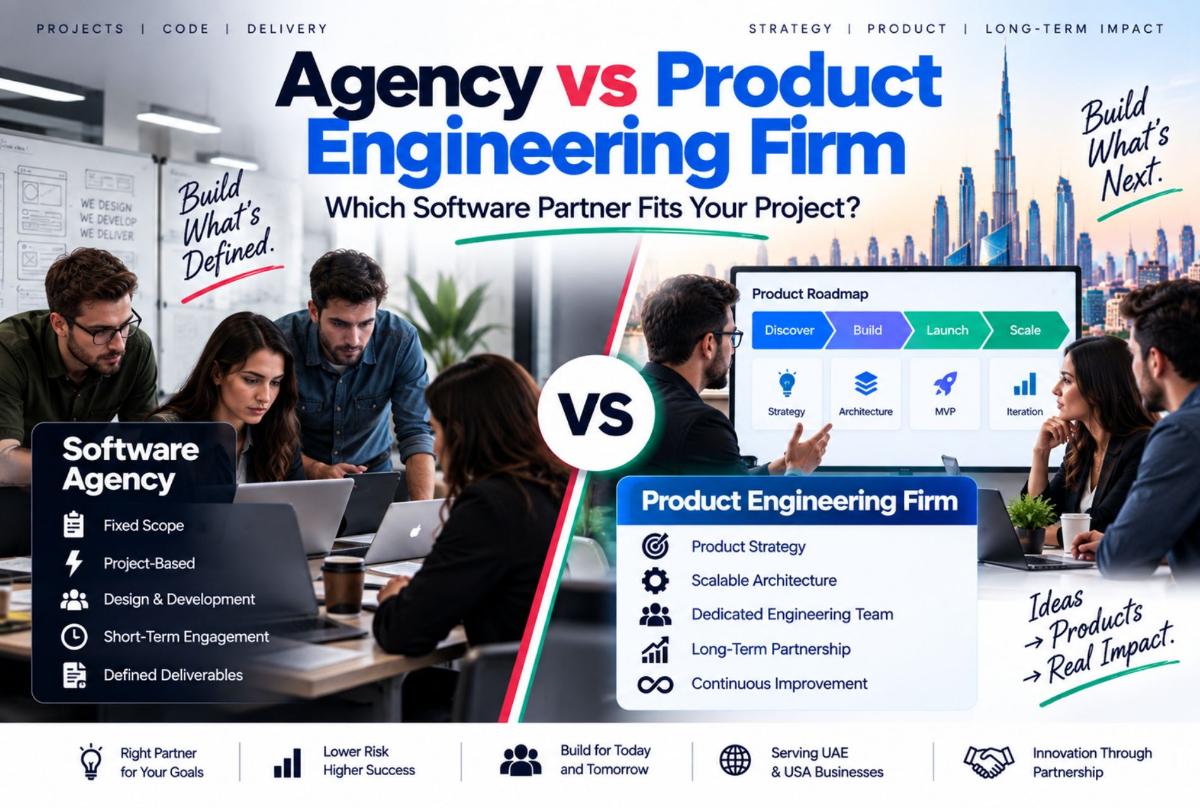
A traditional software development agency often focuses on delivering a defined client project. A product engineering firm is typically structured around building and evolving software products, with greater emphasis on product architecture, engineering decisions, scalability, and continuous development.
Neither model is automatically appropriate for every project. The right choice depends on what you are actually trying to build — especially for founders and operators in the United States and UAE evaluating a custom software development company or SaaS product development company.
Before comparing proposals, use the custom software development company evaluation checklist. For scope control, see how to scope a software development project.
Software Agency vs Product Engineering Firm at a Glance
| Area | Software Agency | Product Engineering Firm |
|---|---|---|
| Primary focus | Project delivery | Product engineering |
| Typical engagement | Defined project | Ongoing product roadmap or complex build |
| Product strategy | May be limited | Often integrated into engineering |
| Architecture | Based on project requirements | Designed around current and future product needs |
| MVP planning | Depends on agency | Usually a core part of product work |
| Long-term iteration | May be separate | Often part of the engagement |
| Custom software | Common | Common |
| SaaS development | Some agencies specialize in it | Core use case |
| Dedicated team | Sometimes | Common |
| Technical ownership | Project-specific | Often continuous |
| Best fit | Clearly defined builds | Products that will evolve |
These are business models and delivery approaches, not guarantees of quality. A company calling itself a “product engineering firm” can still deliver poorly. A highly capable software agency can also provide excellent product engineering. Look at the actual delivery model rather than the label.
What Is a Software Agency?
A software agency generally works with clients to deliver defined digital projects. For example, a company might say: “We need a customer portal with authentication, payments, dashboards and an admin panel.”
The agency scopes the project, estimates the work, assigns a team, and delivers the agreed system.
This model can work well when requirements are relatively clear, the product scope is already defined, you have internal product leadership, you need a specific implementation, and the project has a clear beginning and end.
For example, if your business needs a corporate website or a relatively straightforward internal application, a traditional project-based engagement may be enough.
What Is a Product Engineering Firm?
A product engineering firm is more focused on building software that needs to evolve. That could include SaaS platforms, ERP systems, marketplaces, business operating systems, healthcare platforms, FinTech products, internal enterprise platforms, and AI-powered applications.
The engagement may involve much more than writing code. The team can work through:
- Business problem
- Users
- Workflows
- MVP
- Architecture
- Development
- Testing
- Launch
This becomes important when the software itself is a major part of the business — which is why many founders searching for product engineering services or a dedicated product engineering team are actually looking for long-term product ownership, not a one-off build.
The Real Difference Is Not “Agency vs Firm”
There is a more useful way to think about this. Ask: Do you need someone to build a project, or do you need someone to engineer a product?
Project
You already know what needs to be built.
Product
You know the business problem, but the software will evolve as customers, data, and business requirements change.
That distinction affects architecture, team structure, scope, MVP decisions, technical debt, integrations, roadmap, maintenance, and product iteration.
When a Software Agency May Be Enough
A traditional agency model can make sense when the requirements are straightforward.
Corporate website
You need company pages, services, contact forms, CMS, SEO structure, and analytics. There may be little reason to create a long-term product engineering team around this. See web development.
Internal dashboard
Suppose your company needs a dashboard showing sales, expenses, customers, and reports. If the requirements are stable and the application is relatively contained, a project-based approach may work.
One-time digital project
If there is a defined deliverable with limited future development, you may not need a dedicated product engineering relationship. The mistake is assuming every software project requires the same engagement model.
When a Product Engineering Firm Makes More Sense
Consider product engineering when software is going to become an ongoing business asset.
SaaS startup
You launch with user registration, subscription billing, a core workflow, and a dashboard. Six months later you need new customer types, integrations, a mobile app, automation, analytics, AI features, and enterprise permissions. The architecture needs to accommodate change — see SaaS product development.
ERP platform
An ERP may start with CRM + invoicing, then expand:
- CRM
- Invoicing
- Inventory
- HR
- Procurement
- Reporting
The system is no longer simply a collection of screens. It becomes operational infrastructure — see ERP development and cloud ERP for Dubai SMEs.
Marketplace
A marketplace has multiple sides: customers, providers, administrators, payments, matching, notifications, reviews, and disputes. New requirements will almost certainly appear as the marketplace develops. This is where product engineering becomes more relevant.
Product Engineering Starts With the Product, Not the Code
One of the biggest differences is how the initial problem is approached.
A weak process looks like: Requirements → Code → Delivery.
A product-oriented process looks more like: Business problem → Users → Workflows → MVP → Architecture → Development → Testing → Launch.
That difference can save substantial development effort. Suppose a founder asks for “an AI-powered CRM with 40 features.” A product engineering company should ask: Who uses it? What problem does it solve? Which workflow creates the value? Which features are essential for the first release? What can wait? What data does the AI need? What integrations are actually required?
The goal is not to build the largest specification. The goal is to build the smallest useful product that creates a foundation for the next version.
Product Architecture Matters More When the Product Evolves
Imagine building a house where you know it will eventually have three floors. You do not necessarily build all three floors immediately. But you should think about the foundation before adding the second floor.
Software works similarly. A SaaS application might begin with 100 users and later support thousands. An ERP may begin with one branch and eventually support multiple locations. A marketplace may start in one city and later expand internationally.
The architecture should reflect reasonable future requirements without turning version one into an unnecessarily complex system. Related reading: multi-branch management systems.
The MVP Problem
Many companies confuse an MVP with a small version of the final product. It is better understood as: the smallest product that can validate the core business proposition.
For a booking SaaS, the MVP might need service management, staff availability, customer booking, appointment management, and notifications. It might not need advanced AI, loyalty, marketplace functionality, complex analytics, or ten external integrations.
Those can come later. A product engineering partner should help make that distinction — the same discipline covered in software project scoping.
Dedicated Product Engineering Teams
Another major difference is team continuity. A project agency may assemble a team for the project and move resources after delivery. A product engineering engagement can use a more dedicated structure:
- Product Lead
- Technical Lead
- Frontend + Backend Engineers
- UI/UX + QA
The team develops an understanding of the product over time. That can reduce the need to repeatedly explain business rules, architecture, user behavior, technical decisions, previous mistakes, and product history.
A dedicated software development team or dedicated product engineering team should still be sized to the project — continuity matters more than headcount.
What Happens After Version One?
This is where you should ask difficult questions. Suppose version one launches successfully. What happens next?
Option A
The development contract ends. You find another developer for every new feature.
Option B
The same engineering team continues with the roadmap.
Neither is automatically wrong. But if you are building a SaaS product, switching teams repeatedly can introduce unnecessary friction. A continuing engineering relationship can make more sense when the product roadmap is active.
Technical Debt Is a Product Decision
Technical debt is not simply a developer problem. Imagine a startup asks for a quick workaround because “We’ll fix it later.” Then the workaround becomes part of production. Another feature is built around it. Then another. Eventually, changing the original system becomes expensive.
A product engineering team should understand where speed is useful and where shortcuts create structural problems. The objective is not to eliminate technical debt completely — that is unrealistic. The objective is to understand which shortcuts are acceptable and which ones will constrain the product later.
Product Engineering and Custom Software Are Closely Connected
Custom software is useful when off-the-shelf products do not properly fit the business workflow. Product engineering becomes especially relevant when that custom system is expected to become a long-term platform.
For example: business requirement → custom ERP → multiple modules → multiple user roles → integrations → automation → analytics → AI. At that point, you are not simply commissioning an application. You are engineering a business platform.
Largify positions its custom software development work around purpose-built systems where off-the-shelf software does not adequately fit the workflow.
A Real Example: ValionOS
ValionOS is a useful example of the product engineering model because it is a Largify proprietary product rather than simply a client project.
Largify describes ValionOS as a multi-industry business operating system combining operations, automation, customer management, and AI-powered workflows in a connected SaaS platform. The platform is being developed as a multi-tenant SaaS product with reusable business capabilities and industry-specific templates.
This is fundamentally different from building a one-off dashboard. The product needs to support multiple users, multiple organizations, business workflows, industry-specific modules, permissions, automation, product iteration, and future integrations.
That is the type of environment where a product engineering firm becomes important. Read the ValionOS case study to see how Largify approaches the engineering of a proprietary SaaS platform.
How Product Engineering Changes the Development Process
A product engineering engagement can be structured around continuous learning.
- Discovery
- Architecture
- First sprint
- Product development
- Launch
- Iteration
Largify describes its own delivery approach as Discovery → Build → Launch, with demos, acceptance criteria, and structured sprints.
- Discovery
- Build
- Launch
Agency vs Product Engineering: Cost
This is where many businesses make the wrong comparison. A product engineering team may appear more expensive because the engagement includes deeper technical involvement.
But the actual comparison should be initial development cost versus total cost of building and maintaining the product.
Approach A
Cheap initial build → weak architecture → repeated fixes → new developers → duplicated work → expensive future changes.
Approach B
More deliberate architecture → clearer MVP → documented system → stable engineering team → controlled iteration.
The second approach does not automatically cost less. It may, however, produce a different long-term cost structure. The correct evaluation depends on the complexity and expected lifespan of the product. For buy-vs-build economics in ERP contexts, see Custom ERP vs SaaS cost.
When a Dedicated Product Engineering Team Is Probably Unnecessary
Do not hire a product engineering firm simply because the phrase sounds more sophisticated. You may not need one if:
- You only need a marketing website
- The application is very small
- Requirements are completely fixed
- The software will not evolve significantly
- You already have a strong internal product and engineering team
- You need only a short implementation task
In those situations, a focused development engagement may be more appropriate.
When You Should Seriously Consider Product Engineering
The model becomes more relevant when:
- Software is your core product
- You are launching SaaS
- You need custom ERP
- Your workflows are complex
- You expect continuous feature development
- Your architecture will evolve
- You need a dedicated engineering team
- You do not have internal product engineering leadership
- You expect the software to become business infrastructure
10 Questions to Ask a Product Engineering Company
Before signing, ask:
- How do you define the MVP? If the answer is “everything in the requirements document,” dig deeper.
- Who owns the source code? Get the answer contractually.
- Who controls the repository? Do not leave this ambiguous.
- How do you handle scope changes? There should be a documented process.
- What happens after launch? Understand maintenance and future development.
- Who will actually work on the product? Ask about the technical team.
- How do you approach architecture? You should hear reasoning, not buzzwords.
- How do you measure sprint completion? Look for demos and acceptance criteria.
- What would you remove from our current requirements? This tests product judgment.
- Can you show us something you have actually built? Evidence beats presentation — start with the ValionOS case study.
These questions overlap with the broader software partner evaluation checklist.
How to Compare Two Development Companies
Suppose you have two proposals.
Company A
Lower price, fixed project, large feature list, short delivery timeline.
Company B
Higher price, discovery phase, defined MVP, architecture planning, sprint-based delivery, dedicated team, long-term roadmap.
Do not automatically choose either. Instead, compare:
| Factor | Company A | Company B |
|---|---|---|
| Business understanding | ||
| MVP definition | ||
| Architecture | ||
| Scope clarity | ||
| IP ownership | ||
| Repository ownership | ||
| Team continuity | ||
| Testing | ||
| Deployment | ||
| Post-launch support | ||
| Long-term roadmap |
This gives you a much better comparison than looking only at the quoted price.
Product Engineering for UAE and US Businesses
The engagement model also matters when working across markets.
For a UAE company searching for a product engineering company UAE, you may need Gulf-timezone communication, AED commercial planning, local workflow considerations, Arabic/English experiences where required, WhatsApp-based customer journeys, and UAE-specific integrations — see the UAE market page.
For a US company evaluating a product development company USA, requirements may include US business-hour overlap, SaaS MVP development, product roadmap support, IP protection, scalable product architecture, and dedicated engineering capacity — see the United States market page.
Largify lists both the UAE and United States among its delivery markets and describes its model around product engineering, SaaS, ERP, and custom software on the markets overview.
The Most Important Distinction
Do not ask: “Are you an agency or a product engineering firm?”
Ask: “How will you help us make the product better over the next 12 to 24 months?”
Then listen carefully. If the answer only covers today’s feature list, you are probably discussing project delivery. If the conversation includes product roadmap, architecture, MVP, technical debt, user feedback, scalability, iteration, and ownership, you are discussing product engineering.
That is the real distinction when choosing a software development partner.
Final Takeaway
A software agency and a product engineering firm can both build software. The difference is usually the depth and duration of the engineering relationship.
Choose a project-focused development model when the requirements are clear and the deliverable is relatively contained. Consider product engineering when the software itself is expected to evolve into a major business asset.
For SaaS, ERP, marketplaces, AI applications, and complex business platforms, the decision should be based on more than development price. Evaluate product thinking, architecture, MVP discipline, engineering capability, team continuity, IP ownership, delivery process, scalability, post-launch support, and long-term roadmap.
The right partner is not necessarily the company with the biggest team or the most impressive technology stack. It is the team whose delivery model matches what you are actually trying to build.
Frequently Asked Questions
What is a product engineering firm?
A product engineering firm helps design, build, and evolve software products, often combining product thinking, architecture, engineering, testing, deployment, and ongoing iteration.
Is a product engineering company the same as a software agency?
Not necessarily. Some agencies provide product engineering services, while some product engineering firms operate differently from traditional project-based agencies. The actual delivery model matters more than the label.
Is product engineering more expensive than hiring a software agency?
It can have a higher initial engagement cost because the scope may include discovery, architecture, dedicated engineering, and ongoing product development. Cost should be evaluated against the complexity and expected lifespan of the product.
Should startups hire a product engineering firm?
It can make sense when software is the core business and the startup needs help with MVP definition, architecture, and ongoing development. A simple website or small application may not require this model.
What is a dedicated product engineering team?
It is a team assigned to continuously develop and improve a product rather than simply completing one isolated project.
What is the difference between product development and custom software development?
Custom software describes software built specifically for a business or requirement. Product development usually involves creating software intended to evolve as a product, often with a roadmap, user feedback, and repeated releases.
Build the Product, Not Just the Features
If you are evaluating a software development partner, start by defining what you actually need: a project that gets delivered, or a product that needs to evolve.
That distinction should influence the company you hire, the contract you sign, the architecture you approve, and the team you build around the software.
Largify works across SaaS product engineering, custom software, ERP systems, and AI-powered business operating systems, using a discovery, build, and launch model.
Explore SaaS product development · custom software development · ValionOS case study · how to choose a SaaS development company · vendor evaluation checklist · SaaS MVP: what to build first · SaaS MVP cost · custom SaaS development cost · SaaS development team · development process · custom SaaS vs off-the-shelf.
Start a product engineering discussion — clarify whether you need a project delivery or a long-term product team.