There is no single price for building a SaaS product.
A simple internal SaaS application and a multi-tenant platform with billing, integrations, analytics, AI and complex permissions are completely different projects.
That is why quotes such as “a SaaS product costs $20,000” or “$100,000” are not useful without knowing what is actually being built.
A better question is: What does your SaaS product need to do, who will use it, and what level of product are you trying to launch?
For businesses in the United States and UAE, the development budget can vary significantly depending on product complexity, team structure, integrations, design requirements, security, infrastructure and the scope of the first release.
This guide breaks down the major cost drivers so you can build a realistic budget before speaking with a SaaS development company or evaluating custom SaaS development services. It sits in the Founder & SaaS Product Engineering cluster with how to choose a SaaS development company, custom SaaS vs off-the-shelf software, SaaS MVP cost, what to build first, SaaS development team structure and SaaS product development process.
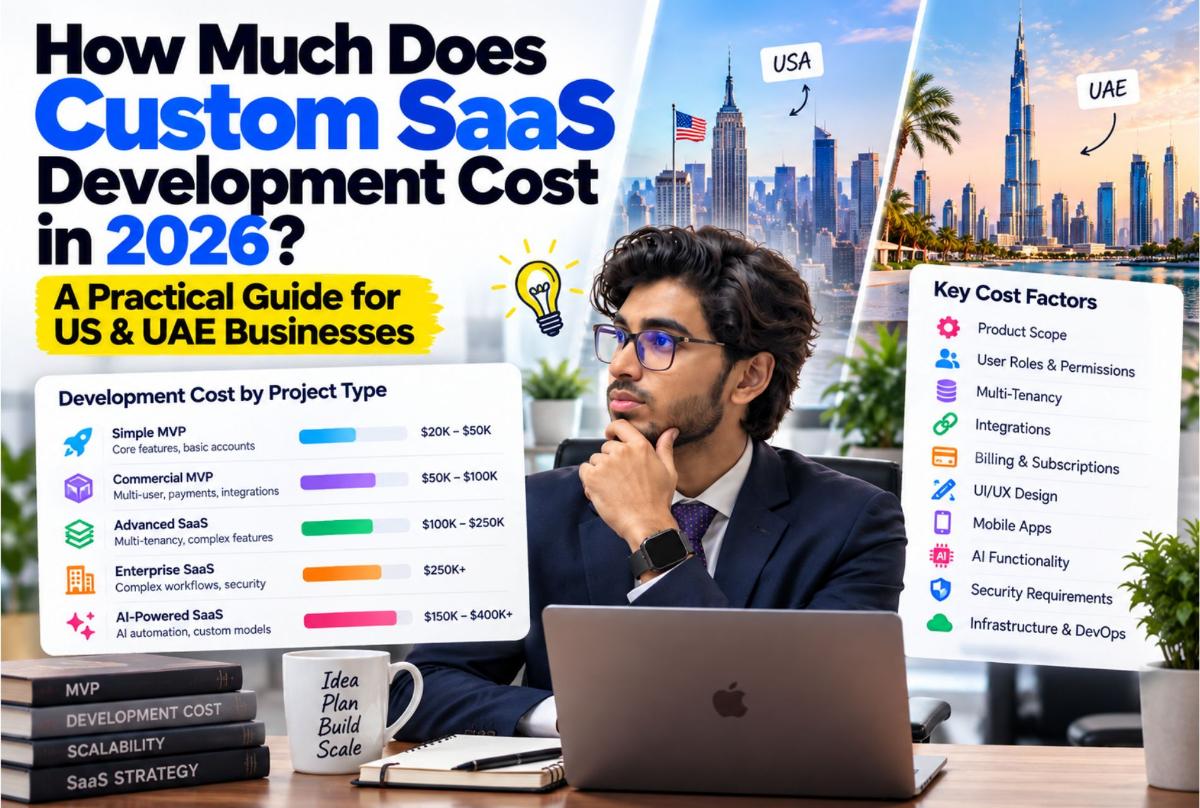
Custom SaaS Development Cost at a Glance
A useful way to think about custom SaaS development cost is by product complexity rather than by a single fixed price.
| SaaS project type | Typical scope | Relative development cost |
|---|---|---|
| Simple MVP | Core workflow, basic accounts, limited features | Lower |
| Commercial MVP | Multi-user product, payments, dashboards, core integrations | Medium |
| Advanced SaaS | Multi-tenancy, complex permissions, integrations, analytics | Higher |
| Enterprise SaaS | Complex workflows, security, integrations, advanced infrastructure | High |
| AI-powered SaaS | SaaS foundation plus AI workflows and automation | Depends heavily on AI scope |
These categories are intentionally broad. A product with ten simple screens can be more expensive than a product with thirty screens if the underlying business logic is significantly more complicated. The number of pages is not a reliable way to estimate SaaS development cost or cost to build a SaaS platform.
What Actually Determines SaaS Development Cost?
The largest cost drivers usually come from the product underneath the interface:
- Product scope
- Number of user roles
- Multi-tenancy
- Business logic
- Integrations
- Billing
- UI/UX complexity
- Mobile applications
- AI functionality
- Security requirements
- Infrastructure
- Testing
- Post-launch development
1. Product Scope
Scope is the first major cost driver. Compare two SaaS products.
Product A
A simple appointment platform: user registration, calendar, appointment creation, customer records, email notifications and a basic dashboard.
Product B
A complete business operating platform: CRM, booking, finance, inventory, HR, customer portal, multiple branches, role-based permissions, automation, reporting, billing, AI agents and third-party integrations.
Both are technically SaaS products. Their development requirements are completely different. This is why a serious SaaS product development cost estimate starts with requirements rather than a generic “cost per app” figure.
2. MVP Scope Has a Major Impact
The first version should not contain everything you eventually want. An MVP should answer: What is the smallest version of this product that can solve the core problem for its intended users?
For example, a property management SaaS might eventually need property management, tenant management, maintenance, accounting, reporting, payments, mobile apps and AI automation. The first version may only need properties, tenants, maintenance requests and a basic dashboard.
That difference can materially change the initial SaaS MVP development cost. The goal is not to build less forever — it is to avoid paying for features before you know they belong in the product. See what to build first in a SaaS MVP and SaaS MVP cost.
3. Multi-Tenant SaaS Architecture
A normal web application might serve one organization. A SaaS platform typically needs to serve many organizations while keeping their data properly separated.
- Tenant A — users, data, settings
- Tenant B — users, data, settings
- Platform enforces isolation
A serious SaaS architecture may therefore need tenant management, organization accounts, user roles, permissions, data isolation, subscription management, usage tracking and tenant-level configuration. Multi-tenancy should be considered during architecture, not added casually after the application has already been built. See SaaS product development.
4. User Roles and Permissions
A simple application might have admin and user. A business SaaS platform may have owner, admin, manager, staff, accountant, customer, vendor and super admin — each with different permissions.
For example, a branch manager might see Branch A but not Branch B. An accountant might access invoices and payments but not HR records. A customer might access bookings and invoices but nothing related to internal operations.
The more complex the permission system, the more product logic needs to be designed and tested.
5. Integrations Increase Development Complexity
Integrations are another major cost factor. Your SaaS product might need to connect with Stripe, PayPal, Google Calendar, Microsoft Outlook, WhatsApp providers, email providers, accounting systems, CRM platforms, cloud storage, maps, analytics or identity providers.
Each integration introduces another technical dependency: API availability, authentication, data mapping, webhooks, error handling, rate limits, synchronization and failure recovery. An integration is rarely just “connect API X.” The real work is making the integration reliable when something goes wrong.
6. Subscription Billing
If you are selling SaaS, billing becomes part of the product — subscription plans, monthly and annual billing, trials, coupons, upgrades, downgrades, cancellations, failed payments, invoices, taxes and usage-based billing.
For example: Starter → 5 users; Professional → 25 users; Enterprise → custom limits. The system needs to know what each customer is allowed to access. Billing therefore affects both the financial layer and application permissions.
7. UI and UX Design
A SaaS product is not just backend logic. Users need to understand the application quickly. A professional SaaS interface may include dashboard, navigation, tables, filters, search, forms, modals, notifications, reports, settings, empty states, error states and mobile responsiveness.
Complex products can require significant UX planning before engineering begins. Poor UX creates another cost after launch because users struggle to understand the product. See UI/UX and product design.
8. Mobile Apps Can Change the Budget
A web-only SaaS product is one development scope. A web application plus iOS and Android applications is another — with additional requirements for mobile navigation, authentication, push notifications, offline behavior where required, device permissions, app-store deployment and mobile-specific testing.
If mobile applications are not essential to the first release, they can often be evaluated as a later phase. Related: mobile applications and cross-platform vs native cost.
9. AI Can Increase Both Value and Complexity
Adding AI to SaaS does not automatically make a product better. The question is what the AI actually does.
Compare a simple AI feature (“Summarize this customer message”) with an AI workflow:
- Customer message
- Classify intent
- Retrieve customer context
- Check account status
- Determine permitted action
- Generate response
- Request approval when required
- Execute action
- Record activity
The second system requires substantially more architecture. AI-powered SaaS can therefore range from a simple API integration to an entire agent-based workflow. See AI automation and integration.
ValionOS as an Example of Complex SaaS Architecture
ValionOS is an example of why SaaS application development cost cannot be estimated simply by counting screens.
The product is positioned as a business operating system rather than a single-purpose application — bringing together CRM, projects, bookings, finance, inventory, HR, customer portals, reporting, automation and AI capabilities.
That means the challenge is not simply creating interfaces. The platform needs shared data, permissions, workflows, automation and a consistent experience across different business functions. That type of product requires substantially more planning than a narrow SaaS MVP.
10. Security Requirements
Security requirements also affect development — authentication, role-based access, encryption, audit logs, session management, password policies, API security, backup strategies, access controls and data retention policies.
If the product handles sensitive business or customer information, security cannot be treated as a final checklist. It needs to influence architecture from the beginning. Related: cybersecurity.
11. Infrastructure and DevOps
A SaaS product needs somewhere to run — application hosting, database, storage, CDN, email, background workers, caching, monitoring, logging, backups and CI/CD.
A small MVP might have relatively simple infrastructure. A larger SaaS platform may require separate environments:
- Development
- Staging
- Production
The infrastructure architecture becomes more important as the number of customers and system dependencies grows. See Cloud & DevOps.
12. Testing
Testing is often underestimated in SaaS budgets. Consider a booking system. You do not only test whether a user can create a booking. You may also need to test double booking, cancellation, rescheduling, time zones, permissions, notifications, payment failures, staff availability, recurring bookings and concurrent users.
The more business logic your product contains, the more important systematic testing becomes.
What Does a SaaS Development Team Cost?
The development team structure affects the overall project budget. A SaaS product may involve a product manager, UI/UX designer, frontend developer, backend developer, QA engineer, DevOps engineer and technical lead.
A small MVP does not necessarily require a large dedicated team from day one. A lean team can sometimes cover several responsibilities. As the product becomes more complex, specialized roles become more important. See SaaS development team structure.
Hiring Developers vs Hiring a SaaS Development Company
Option 1: Internal team
You hire developers directly. Advantages can include long-term control, direct communication and internal product knowledge. But you also take responsibility for recruitment, salaries, management, team retention, technical leadership, QA and infrastructure.
Option 2: Freelancers
This can work for smaller projects. The risk increases when the product requires multiple disciplines, complex architecture, long-term maintenance, strong documentation and multiple integrations. The challenge is often coordination rather than coding itself.
Option 3: SaaS development company
A specialized SaaS product development company or SaaS MVP development company can provide product discovery, UX/UI, development, QA, DevOps, deployment and ongoing development under one engagement.
The important point is to evaluate the actual process rather than assuming every development company provides the same level of product engineering. Compare models in agency vs product engineering firm and use the vendor evaluation checklist.
What Should a SaaS Development Quote Include?
Before comparing proposals, ask whether each quote clearly explains product scope, deliverables, technology, ownership, repository, infrastructure, testing, deployment, documentation, warranty and future development.
A low quote becomes much less attractive when half the required work is outside the scope. Also clarify whether you are buying custom SaaS software development or merely a thin layer of screens on top of incomplete architecture.
Why Cheap SaaS Development Can Become Expensive
Imagine two proposals. Company A quotes less but excludes QA, DevOps, documentation, third-party integrations, production deployment and post-launch fixes. Company B quotes more and includes product discovery, UX/UI, engineering, QA, deployment, documentation, source-code handover and a defined warranty.
The lower number does not necessarily represent the lower total cost. You need to compare what is actually being delivered — the same principle as in custom SaaS vs off-the-shelf software.
How to Reduce SaaS Development Cost Without Destroying the Product
- Reduce the MVP — remove features that are not necessary for the first release
- Use established infrastructure — do not build your own payment system if a suitable provider already exists
- Reuse proven components — authentication, email infrastructure and other standard capabilities can often be handled through established services
- Prioritize workflows — build the workflows that create the core product value first
- Avoid premature mobile development — if users can operate the MVP through a responsive web application, native apps may be a later phase
- Define requirements before coding — changing major requirements halfway through development is expensive
For scoping discipline, see how to scope a software development project.
The Most Expensive Feature Is Often the One You Did Not Define
Scope ambiguity creates development problems. Consider “We need an advanced reporting dashboard.” Does that include revenue, customer growth, employee performance, branch comparison, export, filters, date ranges, scheduled reports and custom metrics?
Until those questions are answered, nobody can accurately estimate the work. Good product specifications turn vague statements into measurable requirements.
A Better Way to Estimate Your SaaS Budget
Instead of asking a development company “How much does a SaaS platform cost?”, give them:
- Product description
- Target users
- Core workflow
- MVP features
- Integrations
- User roles
- Platforms (web, mobile or both)
- Business model
- Geographic market
- Future roadmap (what is intentionally excluded from version one)
That information produces a much more useful estimate for custom SaaS development cost.
Custom SaaS Development Cost for US Businesses
US SaaS products often operate in competitive software markets where the product itself can become the company’s core asset. Important considerations may include speed to MVP, product-market validation, subscription infrastructure, integrations, customer onboarding, analytics, scalability and enterprise readiness.
The development strategy should therefore be connected to the commercial roadmap. A founder does not necessarily need a fully engineered enterprise platform before validating the first version. See the United States market page.
Custom SaaS Development Cost for UAE Businesses
UAE companies may have different operational requirements depending on the industry. A SaaS product serving businesses in Dubai or Abu Dhabi may need to account for multi-branch operations, local payment workflows, Arabic and English interfaces where relevant, regional integrations, business-specific approval workflows, customer portals and local operational processes.
For an internal business platform, the objective may be operational efficiency. For a SaaS company selling software in the UAE, the objective may instead be creating a scalable product. Those are different development projects even if they use similar technologies. See the UAE market page and markets.
Build an MVP Before Building the Entire Platform
This is one of the most important cost-control decisions. Suppose your final SaaS roadmap contains 50 features. Do not assume all 50 belong in version one.
- Phase 1 — Core workflow
- Phase 2 — Commercial functionality
- Phase 3 — Integrations & automation
- Phase 4 — Analytics & AI
- Phase 5 — Enterprise capabilities
This creates a product that can evolve instead of requiring the entire vision to be financed upfront. For more detail, see what to build first in a SaaS MVP.
What Should You Ask a SaaS Development Company?
- How do you define the MVP?
- How do you estimate development effort?
- Who owns the source code?
- Who owns the intellectual property?
- Where is the repository hosted?
- Who owns the cloud accounts?
- How are milestones accepted?
- How are scope changes handled?
- What testing is included?
- What happens after launch?
- How is technical debt handled?
- Can another development team take over the project later?
The last question matters. A product should not become impossible to maintain because only the original vendor understands it.
What a Strong SaaS Development Process Looks Like
- Discovery
- Requirements
- UX/UI
- Architecture
- MVP development
- Testing
- Deployment
- Launch
- Iteration
Each stage exists for a reason. Skipping discovery often creates unclear requirements. Skipping architecture can create technical problems later. Skipping QA moves defects into production. Skipping post-launch planning leaves the product without a clear development path. See the full SaaS product development process.
How Largify Approaches SaaS Product Development
Largify works on SaaS and business software where the objective is not simply to produce screens, but to create an operating product around defined workflows.
SaaS development services and custom SaaS development services can cover product discovery, MVP planning, UX/UI, web and mobile applications, backend systems, APIs, database architecture, integrations, AI workflows, deployment and post-launch development.
The appropriate scope depends on the product. There is no reason to build an enterprise architecture for a product that only needs to validate a simple workflow. There is also no reason to treat a multi-tenant commercial platform like a simple website.
The Real Question Behind SaaS Development Cost
The question is not “How much does SaaS development cost?” The more useful question is: What is the smallest reliable product we can build that proves the business model, and what architecture will allow us to grow it afterward?
That changes the entire budgeting process. Instead of spending money on features because they sound impressive, you allocate the budget around customer problem, core workflow, product differentiation, revenue model, technical requirements and future scalability.
Final Takeaway
Custom SaaS development cost does not have one universal price. The budget depends on the product you are actually building.
A focused SaaS MVP can have a very different scope from a multi-tenant platform with advanced integrations, billing, mobile applications, automation and AI.
For US and UAE businesses, the safest way to plan the investment is to:
- Define the business problem
- Identify the target users
- Separate MVP features from future features
- Map the critical workflows
- Identify integrations
- Define user roles and permissions
- Establish ownership requirements
- Choose an appropriate architecture
- Get milestone-based estimates
- Keep the first release focused
The cheapest SaaS project is not necessarily the one with the lowest development quote. It is the one where the scope, architecture, ownership and business objective are clear before significant engineering work begins.
If you are evaluating a SaaS idea or planning to replace an existing software workflow, explore Largify’s SaaS product development services or discuss the product requirements before committing to a development budget.
Custom SaaS vs off-the-shelf · how to choose a SaaS development company · SaaS MVP cost · team structure · development process · ValionOS.
Building a SaaS product in a specific market? See MVP development for US startups, SaaS development in Dubai and SaaS development in Saudi Arabia.
Frequently Asked Questions
How much does it cost to build a SaaS platform?
There is no universal price. A focused MVP can require substantially less development work than a mature multi-tenant SaaS platform with billing, integrations, mobile applications, analytics and AI.
What is the biggest factor affecting SaaS development cost?
Scope is one of the biggest factors, but architecture, integrations, user permissions, multi-tenancy, security and AI requirements can also significantly affect development effort.
Is SaaS development more expensive than normal web development?
It can be. SaaS products often require authentication, multi-tenancy, subscription management, permissions, dashboards, billing, customer management and ongoing infrastructure that a simple website does not require.
How much does SaaS MVP development cost?
The cost depends on the MVP scope. A small MVP with one primary workflow can be significantly simpler than a commercial platform with multiple user types and integrations. See SaaS MVP cost.
Can I build a SaaS MVP with a small development team?
Yes. The appropriate team size depends on the scope. A focused MVP can often be handled by a lean product team, while larger platforms require more specialized engineering, QA and infrastructure capabilities.
Should I build web and mobile apps at the same time?
Not necessarily. If the product can validate its core workflow through a responsive web application, mobile applications can potentially be added in a later phase.
How do I choose a SaaS development company?
Evaluate its product discovery process, technical architecture, development methodology, ownership terms, milestone structure, QA process, documentation and post-launch support rather than comparing hourly rates alone.