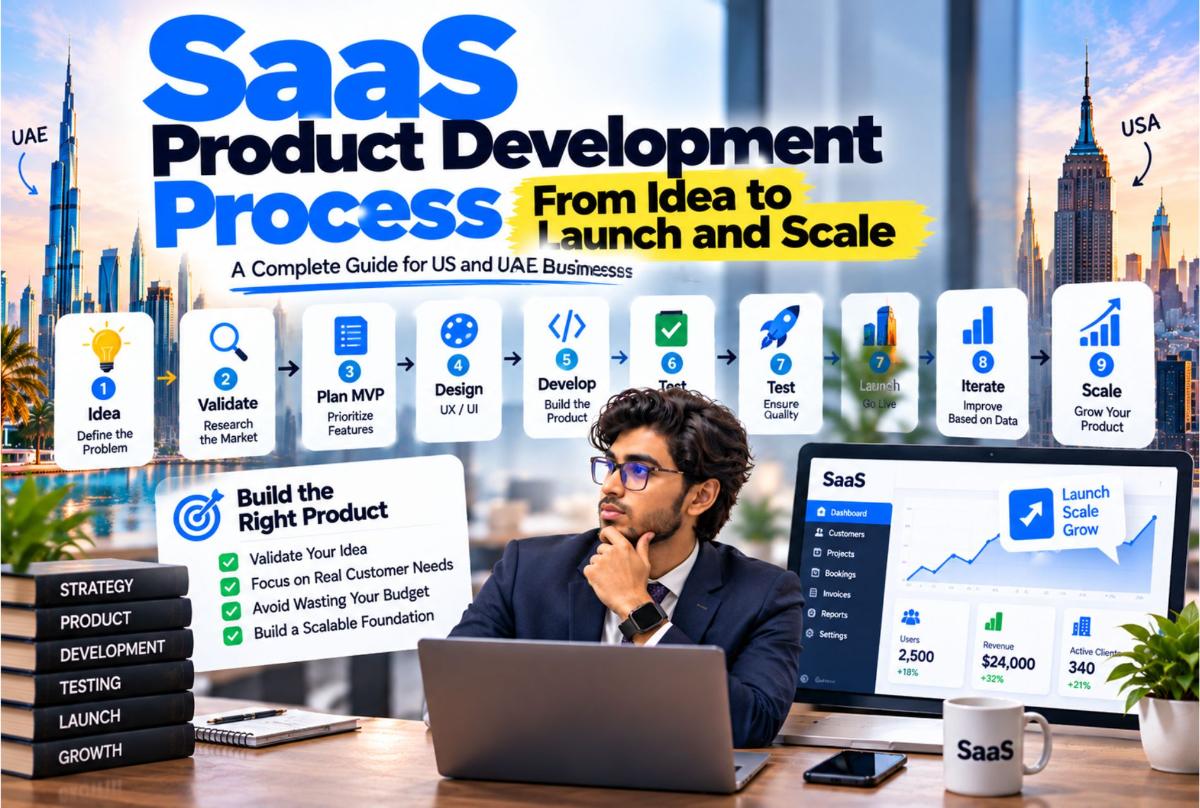
A SaaS product rarely succeeds because someone had a good idea and hired developers to start coding.
The difficult part is turning an idea into a product that people can actually use, pay for, and continue using.
That requires decisions about the customer, the problem, the MVP, product workflows, UX, architecture, development, security, testing, deployment, feedback, and scaling.
For businesses in the United States and UAE, the SaaS product development process also needs to account for the intended market, customer expectations, integrations, operating model, and long-term product roadmap.
A practical process looks like this:
- Idea
- Validation
- Product definition
- MVP scope
- UX/UI
- Architecture
- Development
- Testing
- Launch
- Feedback
- Iteration
- Scale
This article explains what happens at each stage and where SaaS projects commonly go wrong. It sits in the Founder & SaaS Product Engineering cluster with SaaS MVP development, how to choose a SaaS development company, custom SaaS development cost, SaaS MVP cost, SaaS development team structure, and custom SaaS vs off-the-shelf software.
What Is SaaS Product Development?
SaaS product development is the process of designing, building, deploying, and continuously improving software that customers access as a service.
Unlike a one-time software project, SaaS usually involves an ongoing product relationship. Customers may create accounts, subscribe to plans, add team members, use shared workflows, store business data, integrate other systems, upgrade or downgrade plans, and continue receiving product updates.
That means the SaaS development process needs to consider both the initial application and what happens after launch. Explore Largify’s SaaS product development services.
Step 1: Define the Business Problem
Before designing screens, define the problem.
- Who has the problem? For example: multi-branch service businesses.
- What problem do they have? Their bookings, customer records, and branch operations are spread across disconnected tools.
- How do they solve it today? Perhaps through spreadsheets, messaging apps, and multiple SaaS tools.
- What should your product change? A unified workflow.
- Why would they pay? Because the product solves a problem that is expensive, repetitive, or difficult to manage manually.
This gives the development team something concrete to build. Related: how to scope a software development project.
Step 2: Define the Target Customer
A SaaS product cannot effectively target everyone at the beginning.
Consider Product A for independent consultants versus Product B for 100-person professional services companies. Both might technically be project-management SaaS. Their requirements can be completely different.
The second product may need advanced permissions, team structures, approval workflows, reporting, administration, integrations, and enterprise controls.
Define the first customer segment before defining the full feature set.
Step 3: Map the Core Workflow
The next step is understanding what users actually do. For example, imagine a SaaS platform for cleaning businesses. The workflow might be:
- Lead
- Quote
- Customer approval
- Booking
- Staff assignment
- Service
- Completion
- Invoice
The software should make this workflow easier. This is more useful than simply writing “Build CRM + booking + invoicing.” The workflow explains how those components need to interact.
Step 4: Define the MVP
Now decide what belongs in version one. Separate requirements into:
- Must have — Required for the product to solve its core problem.
- Important — Useful but not essential to initial validation.
- Later — Features that can be developed after launch.
- Experimental — Ideas that still need validation.
This prevents the roadmap from becoming the development scope. For prioritization detail, see SaaS MVP development: what to build first.
What Should Not Automatically Be in Your MVP?
Founders often try to include mobile apps, AI agents, advanced analytics, dozens of integrations, custom reporting, white-labeling, complex automation, and enterprise administration.
Some products genuinely need these. Many do not need them immediately.
The correct question is: Does removing this feature prevent the customer from experiencing the core value of the product? If the answer is no, consider moving it to a later phase.
Step 5: Product Requirements
Once the MVP is defined, convert the idea into specific requirements.
Instead of “Users need a dashboard,” define what the dashboard actually does — for example display active customers, display pending bookings, display revenue for a selected period, filter by branch, and allow managers to open related records.
Specific requirements reduce ambiguity between business and development teams during SaaS application development.
Step 6: UX and UI Design
The interface should reflect the workflows defined earlier. A typical SaaS design process may include user flows, wireframes, visual design, responsive behavior, and a design system for buttons, forms, tables, and other components.
Good SaaS UX is not about making every screen visually impressive. It is about making complex workflows understandable. Related: UI/UX design.
Step 7: SaaS Architecture
Once the product requirements are understood, the technical architecture can be defined. This may include frontend, backend, database, authentication, authorization, APIs, file storage, background jobs, notifications, payments, monitoring, and deployment infrastructure.
For SaaS products, architecture also needs to consider multiple customers using the same platform. Related: website vs web application architecture.
Multi-Tenancy Needs to Be Considered Early
Suppose your SaaS has two organizations. Organization A has employees, customers, and projects. Organization B has employees, customers, and projects. The system must maintain appropriate separation between their data.
Multi-tenant architecture can affect database structure, authentication, permissions, APIs, reporting, storage, and administration. It should therefore be considered before large amounts of application code are written.
Step 8: Authentication and Permissions
SaaS products often have more than one type of user — owner, admin, manager, employee, customer. Each role may have different access.
A manager might see branch operations. An employee might only see assigned work. A customer might only see their own records.
Permissions should be designed around actual business workflows rather than added randomly as the product grows.
Step 9: SaaS Development
Now engineering begins. The development phase may include frontend development, backend development, database implementation, API development, authentication, permissions, integrations, billing, notifications, and administrative tools.
The development order should follow dependencies:
- Authentication
- Organization setup
- User roles
- Core records
- Core workflow
- Reporting
This reduces the amount of rework caused by building dependent features in the wrong order. Related: SaaS development team structure.
Step 10: Integrations
Many SaaS products depend on external services — payment providers, email platforms, calendar systems, accounting software, CRM systems, communication platforms, analytics, and cloud storage.
Each integration should have a defined purpose. Do not build integrations simply because a competitor has them. Build the ones required by your target customers and product strategy.
Step 11: Subscription and Billing
If customers pay for your SaaS, billing becomes part of the product. A subscription system may need plans, trials, recurring payments, invoices, upgrades, downgrades, cancellations, failed-payment handling, and usage limits.
- Starter — 5 users
- Professional — 25 users
- Enterprise — custom
The application needs to understand the customer’s subscription and enforce the appropriate permissions.
Step 12: Testing
Testing should happen throughout development, not only immediately before launch.
- Functional behavior — Does the feature work?
- Permissions — Can the correct users access it?
- Integrations — Does the external service work correctly?
- Edge cases — What happens when something unusual occurs?
- Responsive behavior — Does the interface work across relevant devices?
- Regression — Did a new feature break an existing workflow?
For SaaS, testing should focus heavily on the workflows customers depend on.
Step 13: Security
Security should be part of the development process from the beginning. Depending on the product, this can include authentication, authorization, secure API access, secrets management, database permissions, audit logging, backup strategy, access controls, and dependency management.
The exact requirements depend on the type of data and customers the product handles. A SaaS platform processing business information should not treat security as an afterthought. Related: cybersecurity.
Step 14: Deployment
A SaaS application needs a reliable production environment. The deployment process may include:
- Development
- Staging
- Production
A proper deployment setup should also consider environment variables, database migrations, backups, monitoring, logging, error tracking, and deployment rollback.
The goal is to make releases repeatable rather than manually rebuilding the application every time a new version is released. Related: cloud & DevOps.
Step 15: Launch With a Controlled Customer Group
Launching does not mean immediately trying to acquire every possible customer.
A controlled launch can reveal usability problems, missing workflows, confusing screens, performance problems, unexpected customer behavior, and integration issues.
This information is more valuable than assumptions made during development.
Step 16: Measure Actual Product Usage
Once customers start using the product, look at behavior. Useful questions include: Which features are used? Where do users stop? Which workflows take too long? Which features are ignored? What do customers repeatedly request? Where do support questions occur?
The roadmap should increasingly be informed by actual product usage.
Step 17: Iterate Before Scaling
Do not confuse more users with a better product. If ten customers are struggling with the same workflow, adding another hundred customers does not solve the problem.
Fix the workflow first. Then expand. This is one reason SaaS MVP development and product iteration should happen before aggressive scaling.
Step 18: Scale the Product
Scaling can mean different things:
- User scaling — More customers.
- Data scaling — More records.
- Operational scaling — More organizations and employees.
- Geographic scaling — Entering additional markets.
- Feature scaling — Adding more product capabilities.
- Infrastructure scaling — Increasing system capacity and reliability.
The architecture should evolve according to the actual bottleneck rather than adding complexity simply because the product is growing.
SaaS Product Development for US Businesses
For US-focused SaaS products — including teams evaluating a SaaS product development company USA or SaaS development company United States — the development process should be connected to the intended commercial model.
Depending on the product, considerations may include subscription management, B2B integrations, customer onboarding, team permissions, analytics, enterprise requirements, support workflows, and security expectations.
A SaaS product for small businesses should not automatically be designed like enterprise software. See the United States market page and custom B2B software for UAE and USA.
SaaS Product Development for UAE Businesses
UAE SaaS products — including work with a SaaS product development company UAE or SaaS development company Dubai — can also require business-specific workflows.
Depending on the industry, requirements may include multi-branch management, local business workflows, Arabic and English interfaces, payment integrations, staff permissions, customer portals, approval processes, and reporting.
A Dubai-based service company may need very different software from a UAE-based technology startup selling SaaS internationally. The customer profile should drive the product architecture. See the UAE market page and multi-branch management systems.
ValionOS as a Practical Example
ValionOS demonstrates why SaaS product engineering becomes more complex as multiple business functions are brought together.
The platform concept covers CRM, bookings, projects, inventory, finance, HR, reporting, automation, and AI capabilities. These functions cannot simply exist as disconnected modules. They need to share customers, users, permissions, business data, workflows, and reporting.
For example, a customer created in CRM may later become associated with a booking. That booking may create operational work. That work may generate an invoice. The product becomes more valuable when these workflows operate as one system.
This is the difference between building a collection of software screens and building a business platform. Read the ValionOS case study.
How Much Does the SaaS Development Process Cost?
There is no universal price. The cost of custom SaaS development depends on product scope, number of workflows, user roles, multi-tenancy, integrations, billing, mobile requirements, AI functionality, security requirements, testing, infrastructure, and development team.
A focused MVP can be dramatically different from a mature SaaS platform. For a detailed breakdown, see custom SaaS development cost and SaaS MVP development cost.
How Long Does SaaS Product Development Take?
The timeline depends on the scope. A small SaaS MVP with one primary workflow is fundamentally different from a platform with multiple roles, complex business logic, mobile applications, several integrations, advanced reporting, AI, and enterprise controls.
Instead of asking for a generic number of months, ask a development company to break the project into milestones:
- Discovery
- Design
- Architecture
- Core development
- Integrations
- QA
- Launch
This gives you a clearer picture of what is actually happening during the development period.
How to Choose a SaaS Product Development Company
Before hiring a SaaS product development company or custom SaaS development company, evaluate:
- Product understanding — Do they understand the problem?
- SaaS experience — Have they worked with recurring-use software?
- Architecture — Can they explain how the system will work?
- MVP planning — Can they distinguish essential features from later features?
- Ownership — Who owns the source code and intellectual property?
- QA — How is the product tested?
- Security — How are access and data protection handled?
- Documentation — Can another team understand the system?
- Post-launch support — What happens after deployment?
For a deeper evaluation, read how to choose a SaaS development company and the software company evaluation checklist.
Common SaaS Development Mistakes
- Building everything before launching — The product becomes expensive before customer feedback exists.
- Starting with technology instead of the problem — The team chooses a stack before understanding the workflow.
- Treating MVP as low-quality software — An MVP should be focused, not deliberately unreliable.
- Adding AI without a defined use case — AI becomes a marketing label rather than useful product functionality.
- Ignoring ownership — The company discovers later that important technical assets are controlled by the vendor.
- No clear acceptance criteria — Teams disagree about whether a feature is finished.
- Ignoring post-launch development — The product launches without a plan for fixing issues and improving workflows.
Related: agency vs product engineering firm.
What a Strong SaaS Development Roadmap Looks Like
A practical SaaS product development lifecycle might look like:
- Product definition
- UX/UI
- Architecture
- MVP
- QA
- Launch
- Iteration
- Expansion
- Phase 1: Product definition — Problem, users, workflows, and MVP.
- Phase 2: UX/UI — User flows, wireframes, and interface design.
- Phase 3: Architecture — Database, APIs, authentication, permissions, and infrastructure.
- Phase 4: MVP — Core workflows and required integrations.
- Phase 5: QA — Functional, security, and workflow testing.
- Phase 6: Launch — Production deployment and initial users.
- Phase 7: Iteration — Customer feedback and product improvements.
- Phase 8: Expansion — Additional workflows, integrations, automation, and advanced functionality.
This creates a product roadmap rather than one giant development project.
How Largify Approaches SaaS Product Development
Largify’s approach to SaaS software development and SaaS development services focuses on connecting product strategy with engineering.
The process can cover product discovery, MVP definition, UX/UI design, SaaS architecture, web applications, mobile applications, APIs, database systems, integrations, AI workflows, QA, deployment, and post-launch development.
The appropriate scope depends on the product. A simple MVP should not be overloaded with unnecessary enterprise complexity. A commercial SaaS platform should not be built like a temporary prototype.
If you are planning a SaaS product and need a team to take it from product definition through development and deployment, explore Largify’s SaaS product development services or discuss the product requirements.
SaaS Product Development Is an Ongoing Process
The biggest misconception is that SaaS development ends at launch. It does not.
Launch is where real product data begins. After launch, the product needs to evolve based on customer behavior, support requests, product usage, revenue, retention, new workflows, and technical requirements.
A successful SaaS roadmap is therefore not “Idea → Code → Finished.” It is:
- Idea
- MVP
- Launch
- Learn
- Improve
- Expand
That difference changes how you should budget, architect, and manage the product.
Final Takeaway
A strong SaaS product development process connects business strategy with engineering.
The practical sequence is: define the problem, identify the target customer, map the core workflow, define the MVP, design the user experience, plan the architecture, build the core product, integrate required services, test critical workflows, deploy the product, launch with real users, learn from usage, iterate, and scale when the product requires it.
For companies in the United States and UAE, the development strategy should be adapted to the actual customer, business model, and operating environment.
The objective is not to build the largest product possible. It is to build the right product, validate it with real users, and create a foundation that can support what comes next.
If you are turning a SaaS idea into a commercial product, talk to Largify about SaaS product development.
Frequently Asked Questions
What is the SaaS product development process?
It is the process of taking a SaaS concept through product definition, MVP planning, UX/UI, architecture, development, testing, deployment, launch, and continuous improvement.
How long does SaaS product development take?
The timeline depends on the number and complexity of workflows, integrations, user roles, platforms, and other requirements. A focused MVP requires a different development effort from a large multi-tenant SaaS platform.
What is the difference between SaaS MVP development and full SaaS development?
MVP development focuses on the minimum reliable product needed to validate the core proposition. Full SaaS development can include additional integrations, automation, analytics, mobile applications, enterprise features, and other capabilities. See what to build first in a SaaS MVP.
Should a SaaS product use AI?
AI should be included when it solves a defined customer problem or improves a specific workflow. It should not be added simply because the product is marketed as AI-powered. Related: AI & ML services.
Do SaaS products need mobile applications?
Not always. A responsive web application can be sufficient for some products. Mobile applications become more important when customers depend on mobile-specific workflows. Related: mobile app development.
How do I find a SaaS product development company?
Evaluate companies based on relevant SaaS experience, product discovery, architecture, MVP planning, ownership terms, QA, security, documentation, and post-launch support. Price should be compared alongside the actual scope and deliverables. Start with how to choose a SaaS development company.
Explore SaaS product development · build your product · SaaS MVP: what to build first · choose a SaaS development company · custom SaaS cost · SaaS MVP cost · team structure · ValionOS.